








Primary & Secondary School Case Study
Below are graphs, charts, and narrative interpretations demonstrating the impact of the
professional development series on Reading/English and Mathematics scores for all student
groups on a low-performing public, primary and secondary school over a three-year period.
Primary School Study
Below are two charts representing the impact of the professional development series
on Donyall Dickey’s Integrated Approach to Student Achievement on Reading/English and Mathematics scores for all student groups in a low-performing public, primary school after
a 6 Full-Day Workshop Series. DGES demonstrated the most significant gains in the state of
Nevada after the school had previously failed to meet adequate yearly progress for 4 consecutive
years prior to working with Educational Epiphany.
Percent of Population Proficient or Advanced on Criterion Referenced Test (CRT)
English Language Arts (ELA) Assessment
| Student Group |
Performance 2007-2008 Prior to PD |
2008-2009 After Year 1 |
Percent Gain in 1 Year |
| Overall |
50.50 |
62.26 |
+11.76% |
| Asian/Pacific Islander |
62.04 |
78.15 |
+16.11% |
| Hispanic |
41.69 |
53.58 |
+11.98% |
| African American |
42.86 |
50.63 |
+7.77% |
| White |
66.50 |
74.35 |
+7.85% |
| Special Education |
19.50 |
28.57 |
+9.07% |
| Limited English Proficiency |
38.37 |
53.53 |
+15.16% |
| Low SES |
39.65 |
50.27 |
+10.62 |
Percent of Population Proficient or Advanced on Criterion Referenced Test (CRT)
Mathematics Assessment
| Student Group |
Performance 2007-2008 Prior to PD |
2008-2009 After Year 1 |
Percent Gain in 1 Year |
| Overall |
50.50 |
62.26 |
+11.76% |
| Asian/Pacific Islander |
62.04 |
78.15 |
+16.11% |
| Hispanic |
41.69 |
53.58 |
+11.98% |
| African American |
42.86 |
50.63 |
+7.77% |
| White |
66.50 |
74.35 |
+7.85% |
| Special Education |
19.50 |
28.57 |
+9.07% |
| Limited English Proficiency |
38.37 |
53.53 |
+15.16% |
| Low SES |
39.65 |
50.27 |
+10.62 |
Secondary School Study
Below are two bar graphs (and narrative interpretations) demonstrating the impact
of the professional development series on Reading/English (ELA) and Mathematics
standardized scores for all student groups on a low-performing public, secondary
school over a four-year period.
4 Year Analysis of Mathematics Performance
| Student Group |
06-07 Prior to PD |
07-08 |
Gain/Loss |
08-09 |
Gain/Loss |
09-10 |
Gain/Loss |
10-11 |
Gain/Loss |
Total Gain |
Asian
(87) |
84.1 |
98.5 |
+14.4 |
97.5 |
-1.0 |
97.7 |
+0.2 |
98.1 |
+0.4 |
+14.0 |
African American
(297) |
57.5 |
70.5 |
+13.0 |
80.1 |
+9.6 |
80.1 |
0.0 |
87.0 |
+6.9 |
+29.5 |
White
(176) |
71.9 |
84.9 |
+13.0 |
90.3 |
+5.4 |
92.0 |
+1.7 |
94.0 |
+2.0 |
+22.1 |
Hispanic
(94) |
56.6 |
78.7 |
+22.1 |
85.7 |
+7.0 |
86.2 |
+0.5 |
87.2 |
+1.0 |
+30.6 |
FARMS
(218) |
48.3 |
74.7 |
+16.4 |
77.5 |
+12.8 |
75.2 |
-2.3 |
83.3 |
+8.1 |
+35.0 |
Special Ed.
(60) |
9.4 |
24.4 |
+15.0 |
49.0 |
+24.6 |
55.0 |
+6.0 |
66.7 |
+11.7 |
+57.3 |
ELL
(33) |
22.7 |
75.0 |
+52.3 |
77.8 |
+2.8 |
84.8 |
+7.0 |
76.9 |
-7.9 |
+54.2 |
Prior to the implementation of the Integrated Approach, as the chart above displays,
a mere 9.4% or less than 1:10 students with special needs demonstrated an ability
to do mathematics on grade level or above. Similarly, only 22% or 1:5 students
with Limited English proficiency demonstrated competency in mathematics, while
the aggregate passed at a rate of 65.2%. Also noteworthy is the 56.6% pass rate of the
Hispanic population, the 48.3% pass rate of students from households living below
the poverty line (FARMS). Four years later, not only does the aggregate pass the
state mandated assessments at a rate of 90.2% proficient or advanced, but African
Americans, Hispanics, students living below the poverty line (FARMS), Students
with Special Needs (SPED), and English Language Learners (ELL) led the their
non-minority, non-disabled, English proficient peers with 30% to 62.1% gains in
mathematics proficiency since implementing Donyall Dickey's proven instructional
approaches.
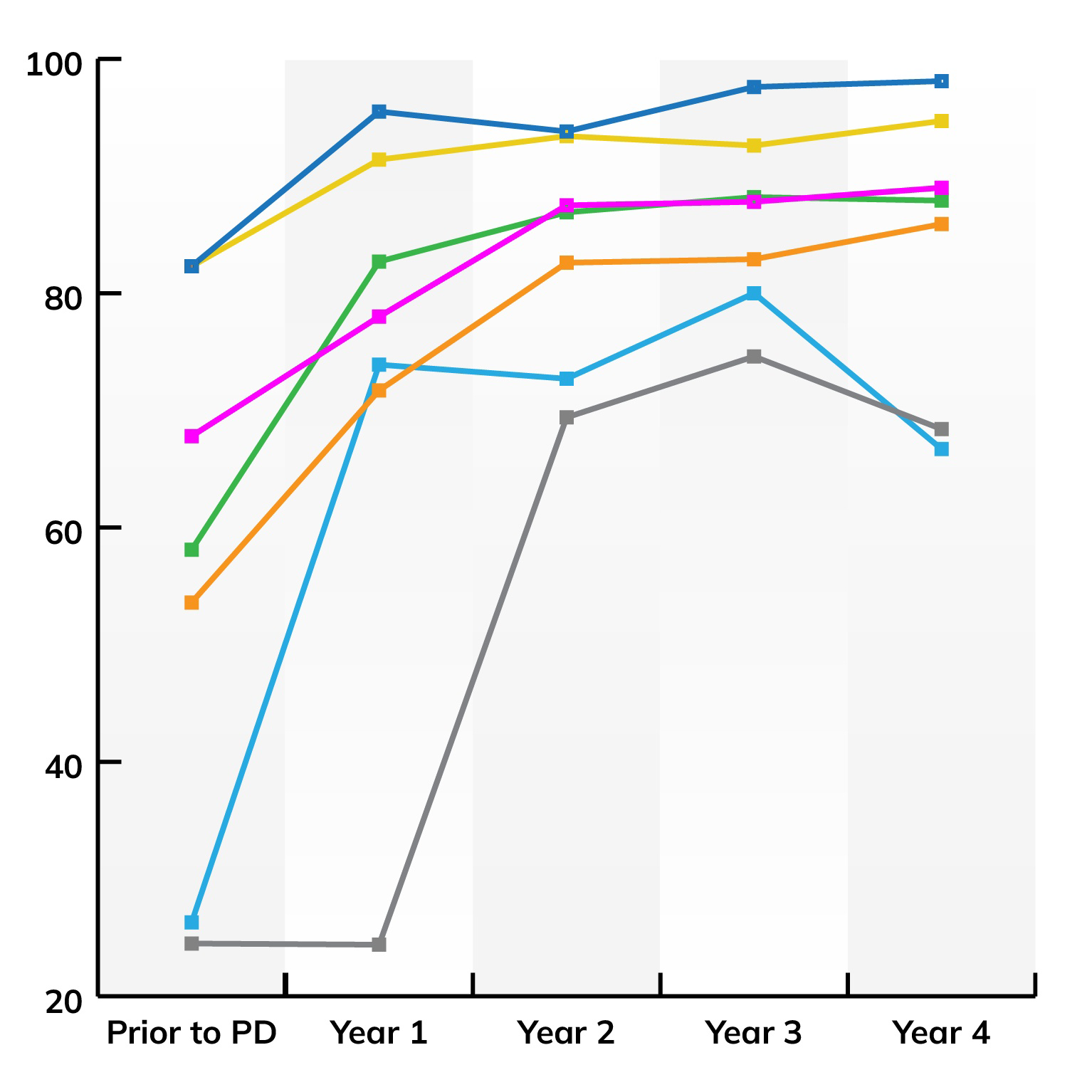
4 Year Analysis of Reading/English (ELA) Performance
| Student Group |
06-07 Prior to PD |
07-08 |
Gain/Loss |
08-09 |
Gain/Loss |
09-10 |
Gain/Loss |
10-11 |
Gain/Loss |
Total Gain |
Asian
(87) |
82.3 |
95.5 |
+13.2 |
93.8 |
-1.7 |
97.6 |
+3.8 |
98.1 |
+0.5 |
+15.8 |
African American
(297) |
67.8 |
78.0 |
+10.2 |
87.5 |
+9.5 |
87.8 |
+0.3 |
89.0 |
+1.2 |
+21.2 |
White
(176) |
82.3 |
91.4 |
+10.2 |
93.4 |
+2.0 |
92.6 |
-0.8 |
94.7 |
+2.1 |
+12.4 |
Hispanic
(94) |
58.1 |
82.7 |
+24.6 |
86.9 |
+4.2 |
88.2 |
+1.3 |
87.9 |
-0.3 |
+29.8 |
FARMS
(218) |
53.6 |
71.7 |
+18.1 |
82.6 |
+10.9 |
82.9 |
+0.3 |
85.9 |
+3.0 |
+32.3 |
Special Ed.
(60) |
24.5 |
24.4 |
-0.1 |
69.4 |
+45.0 |
74.6 |
+5.2 |
68.4 |
-6.2 |
+43.9 |
ELL
(33) |
26.3 |
73.9 |
+47.6 |
72.7 |
-1.2 |
80.0 |
+7.3 |
66.7 |
-13.3 |
+40.4 |
Prior to the implementation of the Integrated Approach, the school depicted above was in School
Improvement Status Year 3, and slated to be reconstituted by its state department of
education. As the chart displays, a mere 25% or 1:4 students with special needs and
limited English proficiency demonstrated competency in reading, while the aggregate
passed at a rate of 75%. Similarly, only half of the Hispanic population and students
from households living below the poverty line (FARMS) demonstrated adequate yearly
progress. Four years later, not only does the aggregate read at a rate of 91.6% proficient
or advanced, but also African Americans, Hispanics, students living below the poverty
line (FARMS), Students with Special Needs (SPED), and English Language Learners
(ELL) have demonstrated 30% to 53.7% gains since implementing Donyall Dickey's
instructional approaches.